
Human-Controlled Agentic Workflows for Banking Operations
FinAssist Command Center is an enterprise orchestration platform designed for financial contact centers handling complex card fraud and dispute escalations. Moving past simple chat interfaces, the system coordinates specialized sub-agents under a central Core Case Router with explicit three-tier governance (Autonomous, Associate Approval, and Mandatory Human Escalation).
Project Overview
This is a concept project. Metrics shown in the prototype are scenario or evaluation data, not production customer or business results.
MyFinAssist is a concept banking operations console for investigating complex customer cases. It helps associates move from a customer issue to evidence, recommendation, human review, specialist handoff and resolution
- The Problem: Contact center associates spent 70% of an 8-minute dispute call locating records across five legacy banking systems, driving high handle times and inconsistent provisional credit decisions.
- The Solution: A desktop command center powered by a Core Case Router that coordinates four specialized investigation AI agents (Triage, Fraud, Account, Policy) with a strict four-tier governance model
- Core Innovation: Dual-surface design pairing a live operator workstation with a real-time customer mobile view, coupled with engineered failure states (tool timeouts, low confidence, agent disagreements)
- Key Results: Intake handle time dropped from 8m 14s to 3m 42s (-55%); specialist handoff prep fell from 4m 30s to 1m 15s (-72%); zero regulatory missed deadlines on 1,840 evaluation cases.
The Problem (Who & Why)
When a banking customer spots an unfamiliar charge on their mobile statement, their problem is straightforward: "I did not make this $420 purchase, and I need my money back."
A customer reports, "I do not recognize this $420 debit card charge." The customer sees one problem. The operator may need to verify identity, inspect the transaction, check device and location signals, review policy, prepare a dispute, decide whether provisional credit is appropriate, block the card, communicate next steps and determine whether a specialist must take ownership.
The Core Product Problem:
- Regulatory Pressure: Regulation E requires financial institutions to issue provisional credit within 10 business days on unauthorized electronic fund transfers.
- Siloed Banking Data: Associates had to toggle between 5 disconnected tools during a live call: core ledger, merchant code lookup, card network authorization logs, risk scoring engine, and policy PDFs
- Operational Bottleneck: Associates spent 5 to 6 minutes of an 8-minute call copying data between screens, leaving under 2 minutes for customer empathy and actual decision-making.
Multiple User Groups & Needs
Frontline Associates (L1)
Mental Model: Conversational, fast, with clear guardrails
Need: Immediate case status, clear next steps, sync with user, Speed & reassurance
Fraud Specialists & L2 Investigators
Mental Model: Evidence first, Signal inspection, log verification
Need: Raw payload logs, packet traces, immutable audit trails, policy references, Deep forensic context
Operations & Governance Leads
Mental Model: Risk envelopes and audit compliance
Need: Policy governance, error bounds, what-if simulations
Technical Operations
Mental Model: System health and API status
Need: Reliability & monitoring
Foundational Experience & Interface Mechanics
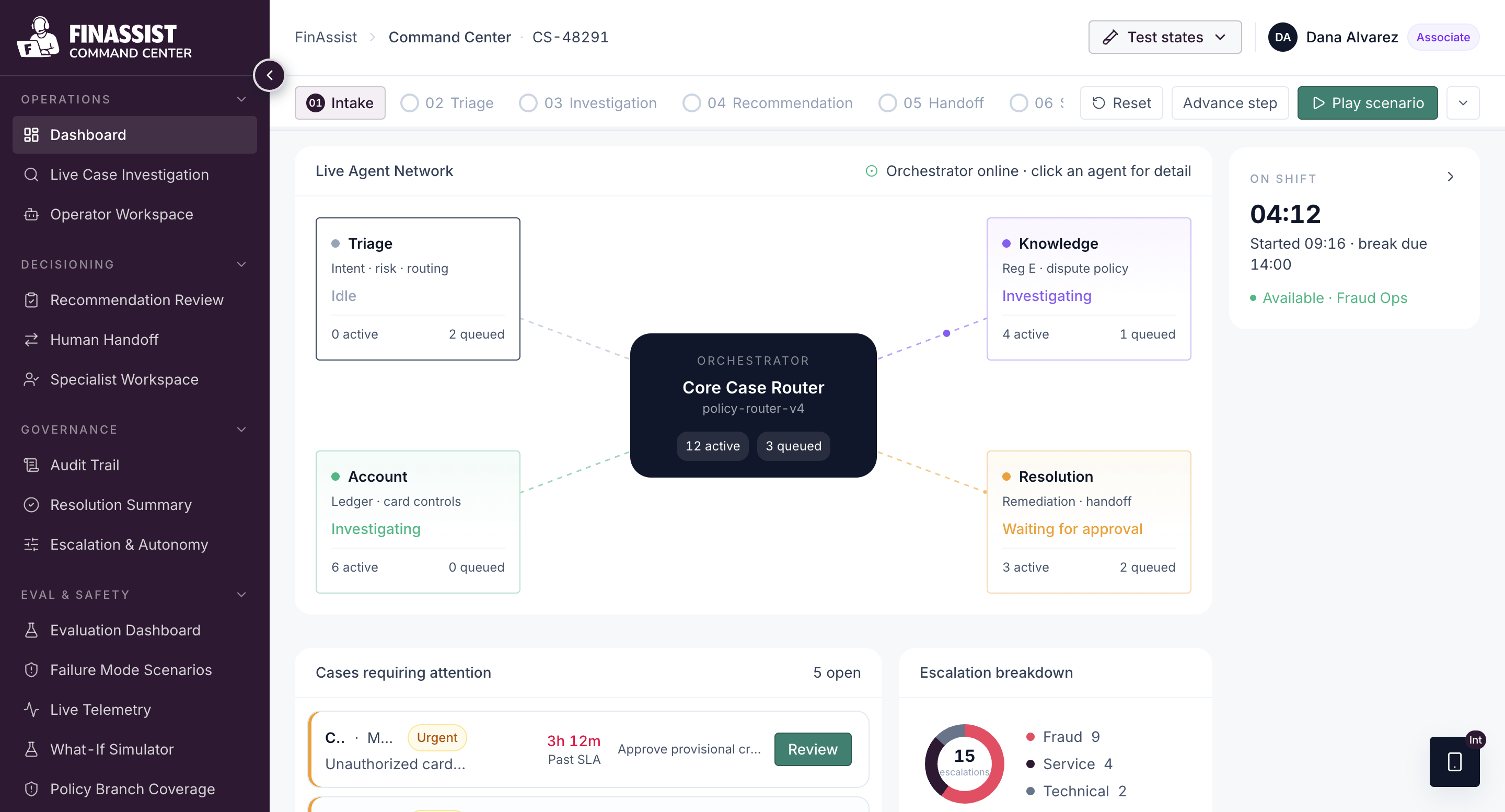
- Collapsible Navy Navigation: Fixed 258px sidebar collapses to a 68px icon rail via a floating toggle, giving specialists maximum horizontal canvas for dense data tables.
- Pinned Seven-Stage Stepper: A persistent top bar tracks case progress (Intake → Triage → Investigation → Recommendation → Handoff → Specialist → Resolved). It keeps operators anchored during escalations.
- Floating Customer View: A draggable mobile device frame mirrors what the cardholder sees in real time, eliminating associate uncertainty about customer notifications.
- Context-Adaptive Main Stage: The workspace changes based on the case state, switching from a triage summary to an evidence matrix, a handoff diagnostic, or a degraded-mode alert.
The AI Opportunity & Strategic Rationale
Shift: Service-Driven to Intent-Driven
- Old method (Service-driven): The associate opened the ledger, ran an account lookup, navigated to the transaction log, and manually calculated dispute eligibility rules.
- New method (Intent-driven): The customer reports "I never made this $420 charge." The system recognizes the intent, triggers the required checks in parallel, and presents an assembled reports.
Why an Agentic Architecture?
- Why not a fixed rule tree? Financial disputes have too many branching variables (merchant category, reporting delay, account age, cross-border fraud signals). Fixed scripts broke whenever data was missing
- Why not a single chat prompt? Monolithic LLM prompts fail banking compliance audits. They produce unverified summaries and cannot guarantee deterministic execution of ledger actions.
- The Agentic Advantage: our modular, single-responsibility agents run targeted API calls in parallel. A central Core Case Router synthesizes their outputs into an auditable recommendation.
Four specialist AI agents:
Triage
Intent, Risk and Routing.
Account & Transaction
Ledger, Card, Device and Transaction Evidence.
Knowledge & Policy
Policy Citations, Playbooks and Guardrails.
Resolution & Escalation
Remediation plan, Dispute Draft and Specialist Handoff.
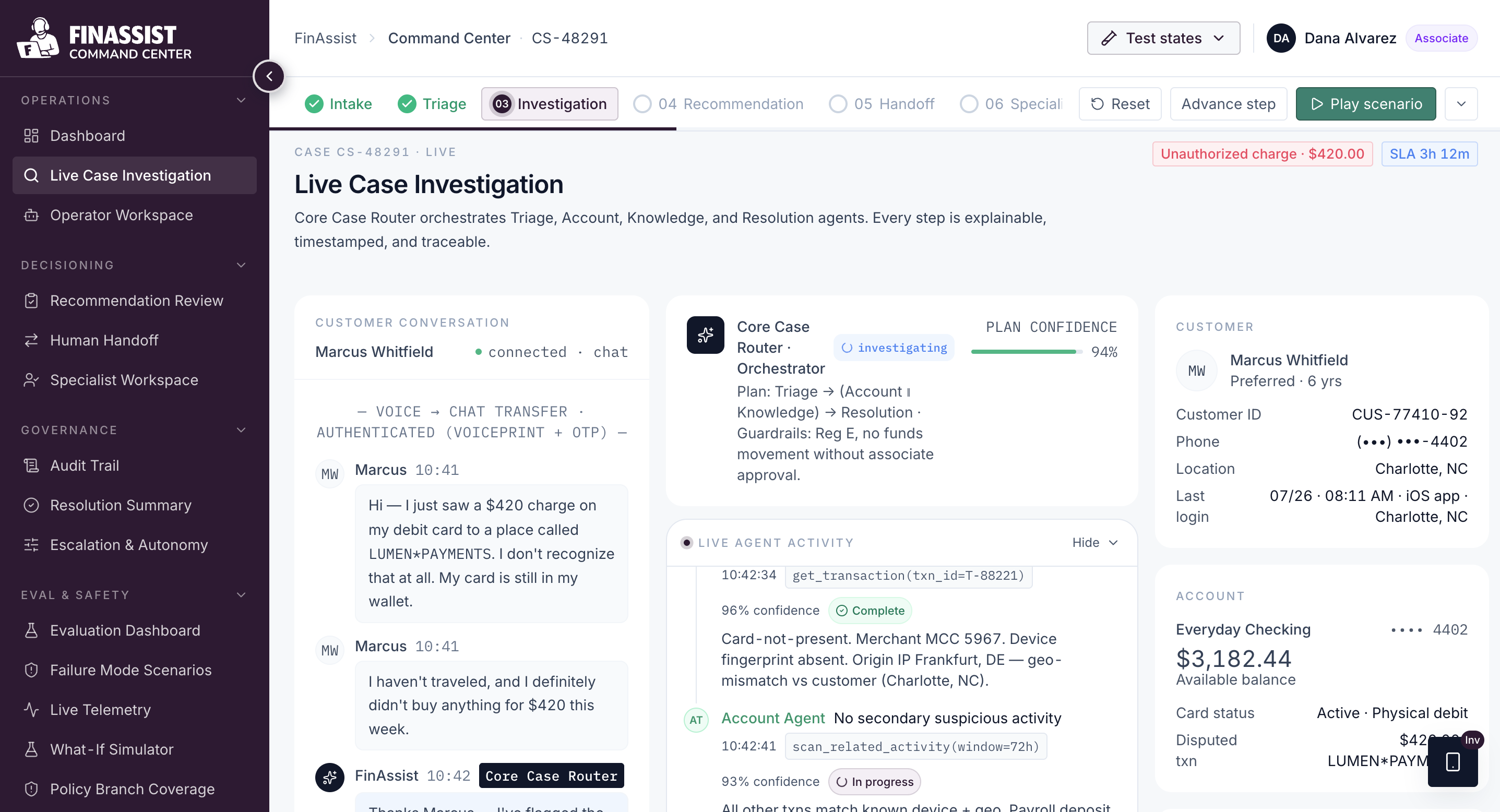
The case begins with an authenticated customer conversation. The Core Case Router creates a plan, sends work to specialist agents, and keeps the investigation visible.
Agentic UX & Division of Labor
The Six-Stage Interaction Loop:
- Intent Extraction: Customer states issue; Triage Agent identifies unauthorized debit card dispute ($420, LUMEN*PAYMENTS, Frankfurt DE).
- Parallel Fan-Out: Core Case Router dispatches Account Agent (history, balance), Fraud Agent (geo, device, velocity), and Policy Agent (Reg E compliance).
- Synthesis: Router aggregates findings into a 2x2 evidence grid with a composite confidence score (0.84).
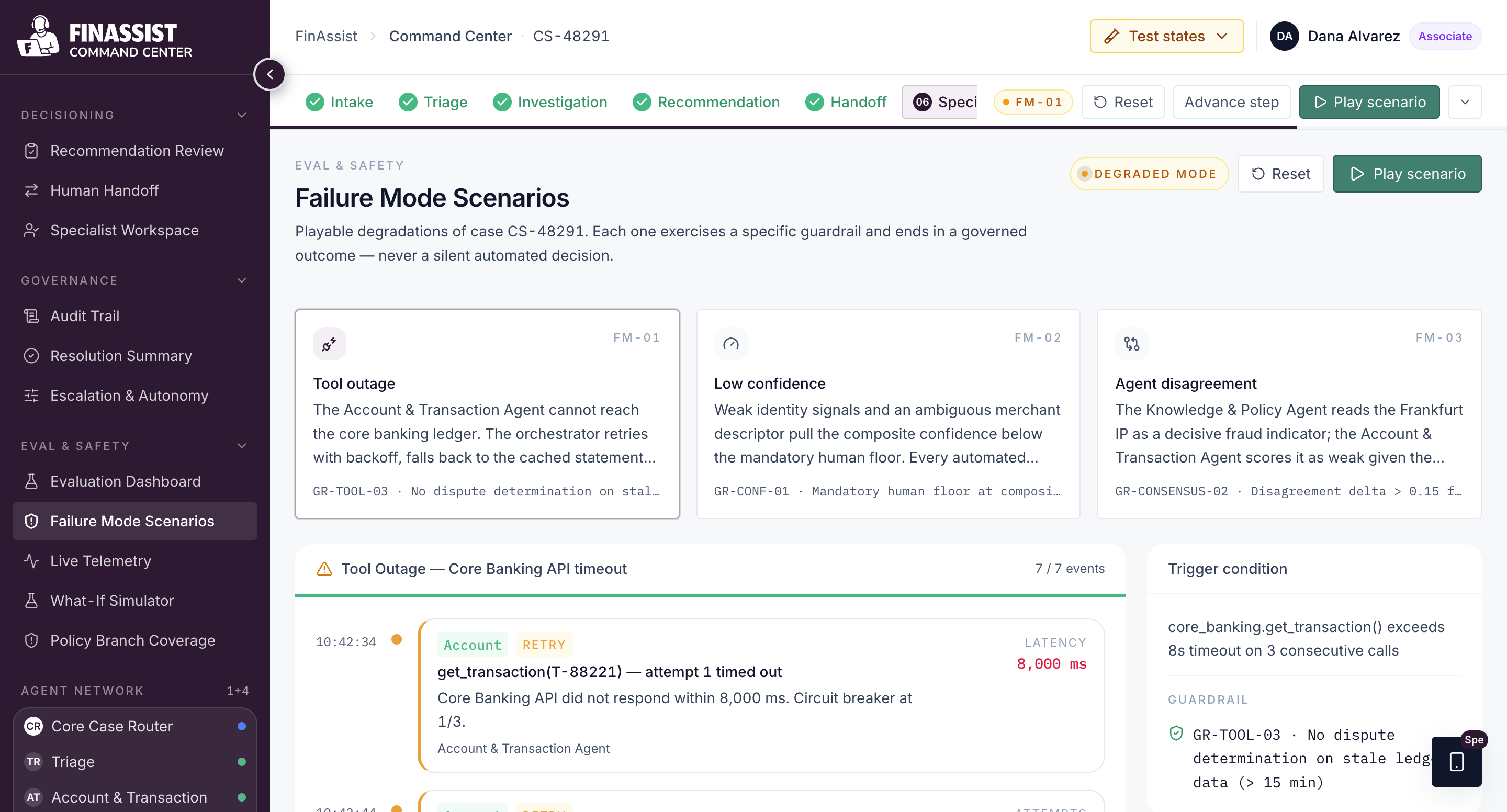
- Human Review: Associate verifies signals (device mismatch confirmed, 48-month clean tenure, reported within 4 days).
- Controlled Execution: Associate approves recommendation; Router triggers card suspension, replacement issuance, and provisional credit.
- Verified Outcome: Real-time ledger confirmation logged to audit trail; confirmation pushed to customer mobile screen.
Division of Labor Matrix
AI in the Design Process
Where AI Accelerated the Design
- Synthetic Banking Data: Used LLMs to generate 1,840 realistic, compliant dispute transcripts with varying fraud vectors, merchant codes, and reporting timeframes.
Where Human Judgment Was Required
- Rejecting Automated Approvals: Early automated runs showed the model wanted to auto-credit clean accounts under $500. I overrode this to mandate human associate review on all charges above $250.
- Treating Escalation as a Normal State: Product teams often treat human handoffs as system failures. I designed handoffs as standard operational safety gates with dedicated prep screens.
- Eliminating Black-Box Confidence Scores: Replaced single percentage badges with transparent, breakdown radials showing individual agent contributions.
Designing for Failure
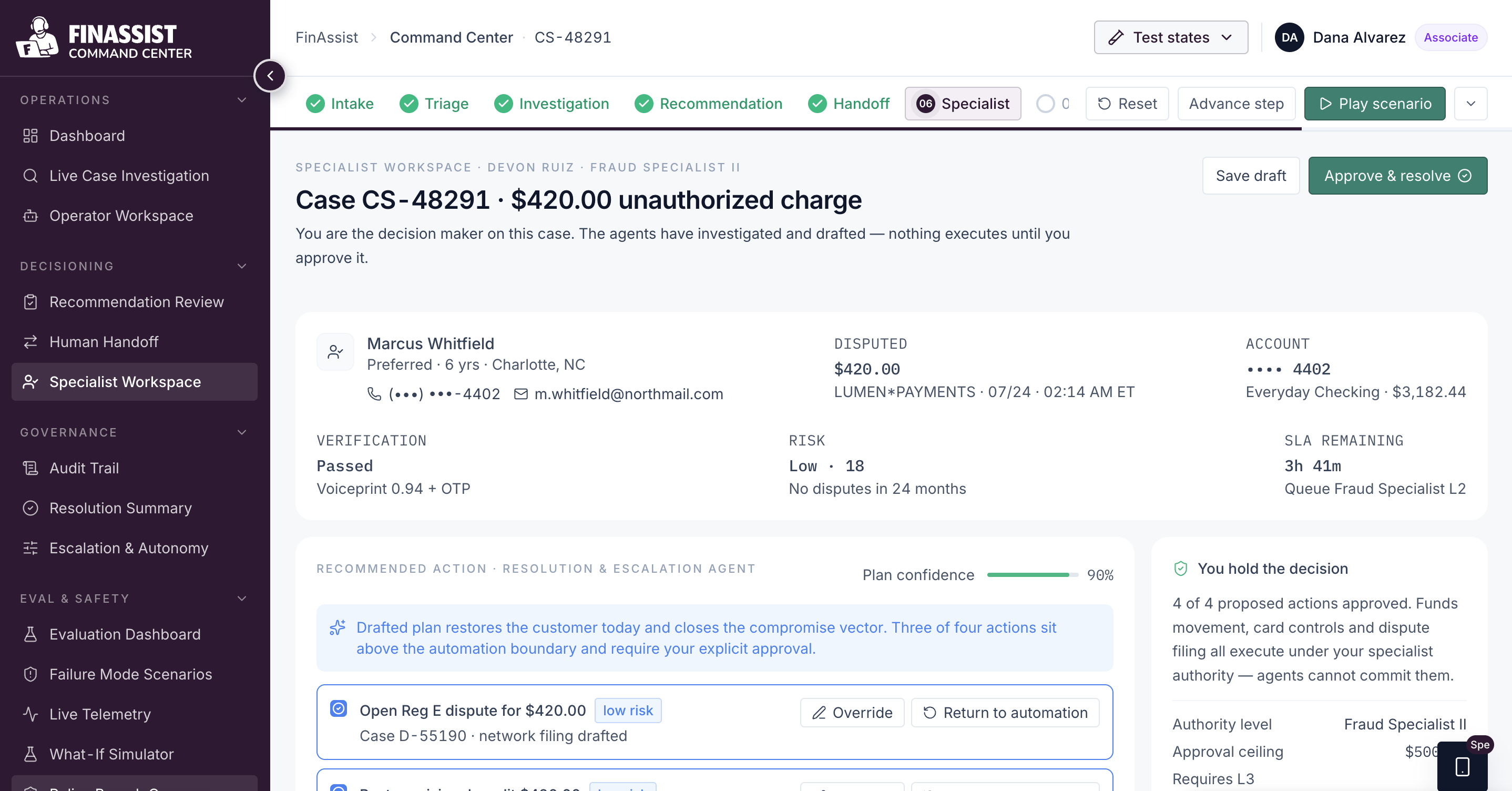
- Tool outage: retry with backoff, use a cached service when possible, then escalate when evidence is too stale for a Reg E determination.
- Low confidence: withdraw automated actions and force human review.
- Agent disagreement: detect a confidence spread above the threshold and force review instead of selecting a winner silently.
The failure-mode suite makes degraded behavior part of the product rather than treating it as a technical exception.
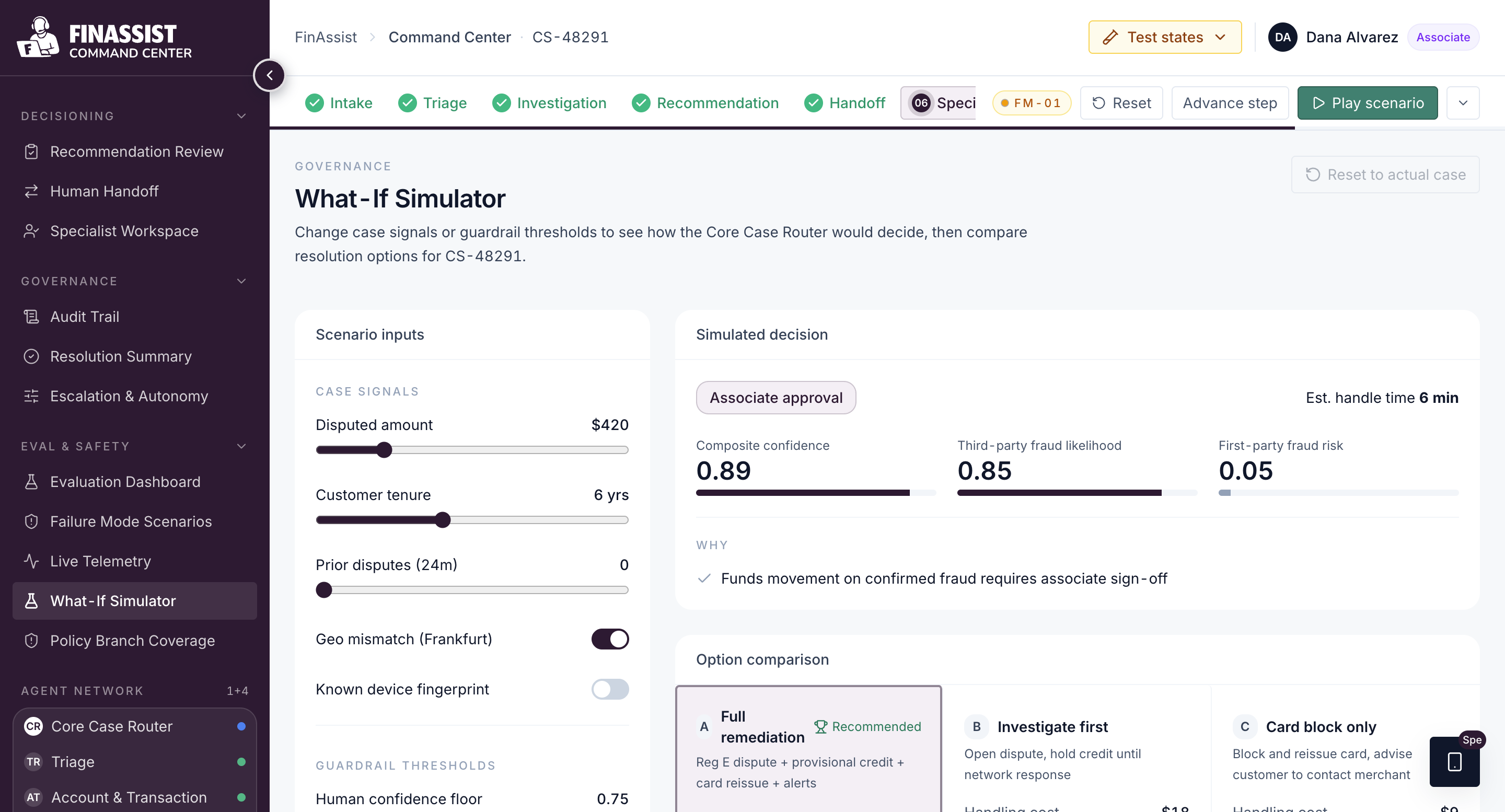
What-If decision making
The simulator lets governance teams explore how a change in value ceilings or confidence floors could affect routing, risk, handling time and compliance before changing live rules.
What is proven and what is not
What the prototype demonstrates
- A complete case journey from intake to resolution.
- A clear division between the Core Case Router, specialist agents and human operators.
- Action-level authority and human approval gates.
- Governance, audit and failure-state concepts.
- Offline evaluation and runtime monitoring concepts.
What is still unproven
- Real-world usability with banking operators.
- Whether the workflow reduces actual handling time in production.
- Whether the proposed agent boundaries match real operational policy.
- Whether predicted customer satisfaction matches real customer responses.
- Whether the edge-case suite passes consistently with real integrations.
Next validation
I would test the prototype with frontline operators and fraud specialists using realistic cases. I would measure time to understand the case, time to reach a decision, explanation quality, approval accuracy, handoff reconstruction effort and override reasons.
Final reflection
FinAssist started as an exploration of an AI-powered banking assistant. The updated concept became a broader operations system. The strongest design decision was not the agent architecture itself. It was making responsibility visible throughout the case.
The Core Case Router coordinates the work. Specialist agents gather and organize evidence. The operator reviews recommendations. A specialist takes ownership when the case crosses a boundary. Governance defines the rules. The audit trail records what happened. Failure modes define what happens when the system cannot safely continue.
The principle I would carry into a real product team
Automate the work people should not have to repeat. Keep the decisions people should still own visible.